Triskaidekaphobia: Fearing the Number Thirteen
Peter Prevos2220 words13 November 202612 min read
Today is Friday the thirteenth, an auspicious day for the superstitious people. So whatever you do, don't break a mirror while walking under a ladder, looking at a black cat.
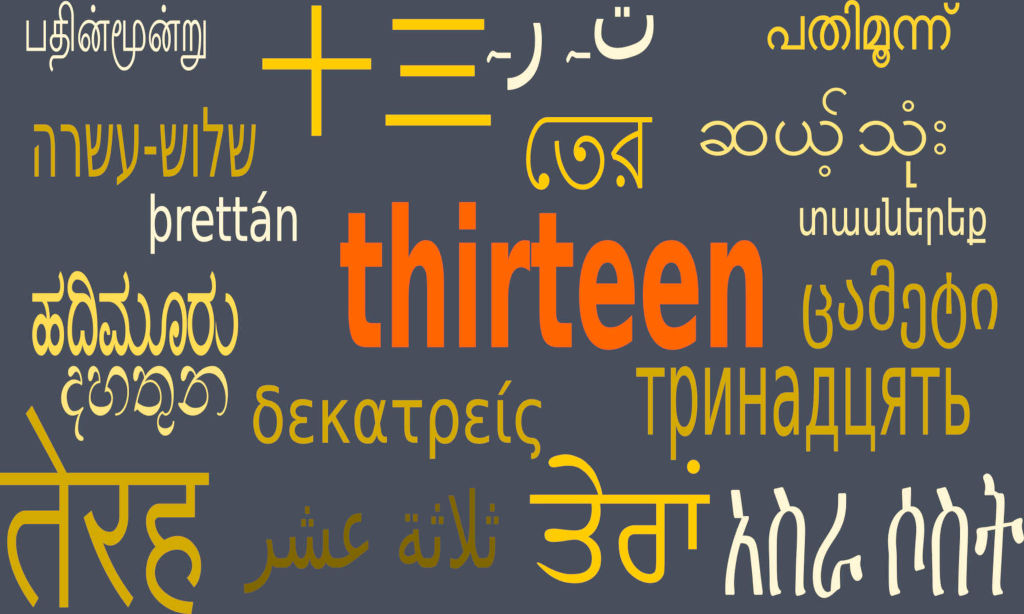
Why does an abstract entity such as a number elicit a feeling of fear or any feeling at all? This article discusses the rational mathematical and esoteric numerological meaning of the number thirteen and its associated calender day.
Mathematical Meaning
Attaching meaning to numbers is as old as mathematics itself. The ancient Greek philosopher Pythagoras developed mathematics as a mystical art where each number has meaning. The Pythagoreans believed, for example, that odd numbers were masculine and even numbers feminine.
Contemporary mathematicians might no longer believe in the divine nature of numbers, but they do attach meaning to them. Te main job of a mathematicians is to discover patterns, including those in numbers. But these patterns are just as much guided by aesthetics as they are by logic.Numbers can be amicable, perfect, sociable, palindromic, lucky and so on. The On-Line Encyclopedia of Integer Sequences provides thousands of lists of natural numbers collected by mathematicians.
Mathematically speaking, the number 13 quite ordinary. It is the first number after twelve, and the sixth prime number. Thirteen is also a happy number (a number which eventually reaches 1 when recursively summing the squares of the digits: \(1^2 + 3^2 = 10, 1^2 + 0^2 = 1\). Paradoxically, 13 is mathematically a lucky number because it survives a process of logical elimination. But this status is not unique as there are infinitely many lucky numbers that result from this algorithm.
Numerology
In esoteric thought, numbers are imbued with meaning guided by a belief in a relationship between numbers and the structure of social reality. Numerologists try to describe your personality by converting a name to numbers or divine your future by analysing your birth date. This approach contrasts with the scientific version in which numbers express the physical world. The esoteric is not based on a theory of the social world but the intrinsic mystical nature of numbers.
The meaning of numbers in numerology is not bound by rules, as it is in mathematics, a form of mysticism. The significance of numbers relies on symbolical connections between numbers and how we perceive the world. The meanings of numbers are not constant and depend on the psychology and cultural background of the interpreter.
In our case, the fear of the number 13 is not prevalent in every culture. In China, four is considered unlucky, and in Italy, some see 17 as the unlucky number.
Triskaidekaphobia: Fear of the number thirteen
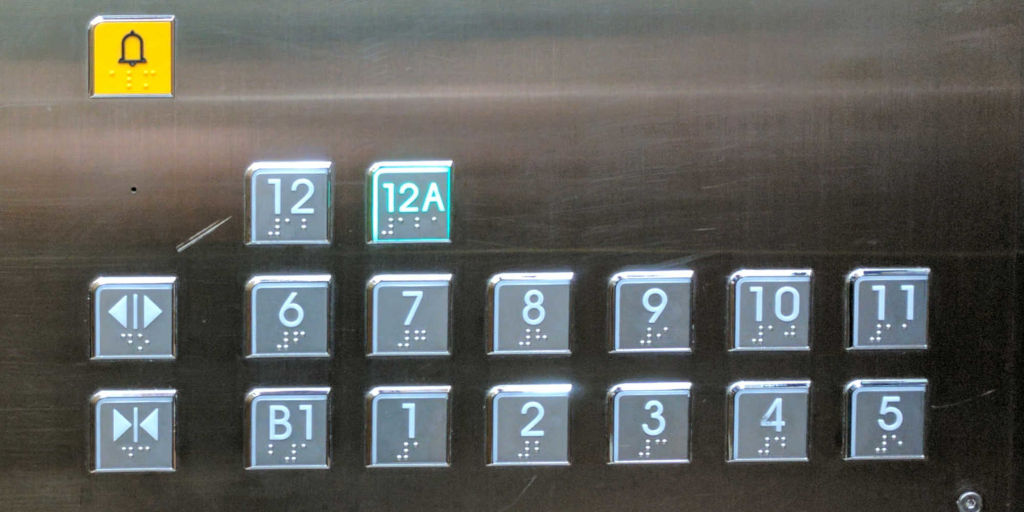
A little while ago, I was in Vietnam and stayed on the thirteenth floor of the hotel. Going to my room, I noticed that the button for the number 13the floor was instead 12A. It is interesting that this elevator control panel only has the thirteenth floor missing and not the fourth floor, which is traditionally an unlucky number in Vietnam and China. The missing thirteenth floor seems to be common as I also encountered it the lift of a hotel in Wellington.
The technical term for fear of the number 13 is Triskaidekaphobia. This word is derived from Ancient Greek is a compound of tris (three), kai (and), deka (ten), and phobos (phobia or fear). American psychiatrist Isador Coriat (1875–1943) was the first to use this term in his 1910 book Abnormal Psychology. The word itself is scarier than the number.
The origins of the symbolism around number 13 are uncertain. Some seek it in Judas Iscariot being the thirteenth apostle. Lachenmeyer's view is that the mythology around this number was popularised in the 19th-century. American civil war veteran William Fowler established the Thirteen Club which held exclusive dinner parties. During these parties, the 13 members ridiculed superstitions by walking under a ladder another fun party games. Their ventures, unfortunately, had the opposite effect as the popularity of this club also infected the world with triskaidekaphobia. Popular culture has spread this superstition around the world and made it a global phenomenon (Lachenmeyer, 2004; Milosevic & McCabe, 2015).
Paraskevidekatriaphobia, Fear of Friday the 13th
Friday the thirteenth is feared by some but ignored by most. The thirteenth day of the month falling on a Friday is not a good time to walk under a ladder because you might trip over a black cat and shatter a mirror into a thousand pieces. Fear of the number thirteen, or triskaidekaphobia, is the irrational fear that this number negatively influences our fortunes. The even bigger tongue-twister paraskevidekatriaphobia means a fear of Friday the 13th.
The special status of the number thirteen, and Fridays falling on that day of the month, forms part of the folklore and superstition of Western culture. It is easy to deny the objective reality of this superstition, but the phenomenon is undoubtedly fascinating from a cultural perspective. From where does this fear originate? What is so special about the number thirteen? Do unfortunate events hide a sinister regularity that causes them to cluster on any Friday on the thirteenth day of the month?
The number 13 might be unlucky in itself, but combining it with a Friday is even worse. Every year has between one and three days where a Friday is the thirteenth day of the month. In fact, the 13th day of the month is more likely to be a Friday than any other day of the week (Baxter, 1969).
The scientific term of the fear for Friday the thirteenth is scarier than the day itself. Therapist Donald Dossey first coined the word paraskevidekatriaphobia. He claimed that anyone who can pronounce it would be instantly cured of their irrational fear.
But why is Friday the 13th unlucky? Friday has been an unlucky day in European culture since the Middle Ages. As early as 1390 Chaucer wrote: "And on a Friday fell all this mischance". Traditional Catholicism sees Friday as a day of penance, which made people focus on their perceived sins.
The first time that anyone mentioned that Friday the thirteenth might be unlucky as in 1913. Friday the thirteenth has become synonymous with bad luck. Perhaps mostly because of the eponymous movie from 1980.
The relationship between Fridays on the thirteenth day of the month is not a reality but a cultural meme that spreads through culture. The development of mass media has accelerated the dispersion of these ideas, not because they are real but because they are poetic. Paraskevidekatriaphobia has only become a broad phenomenon after the release of the classic horror flick Friday the 13th.
Scientific Research into Friday the Thirteenth
Fear of the number thirteen is irrational because there is no reason to believe in a causal relationship between the amount of bad luck and a specific number. Triskaidekaphobia is an irrational fear of the number thirteen because a number has no agency. Numbers cannot be the cause of anything as they are human inventions, not things that exist in the world.
The success of science shows that nature follows predictable patterns, but bad luck is a human construct and not something that exists in reality. Whether we like it or not, the universe does not care about how lucky we are.
Even though the irrationality of this fear is apparent, many finance and health professionals believe that Friday the thirteenth is an unlucky day. This superstition has raised the curiosity of some academics. Several researchers in these two areas have published articles where they asked why is Friday the 13th unlucky.
Finnish health researcher Simo Näyhä (2002) published a controversial paper in which he suggested that women are more susceptible to superstition. This fear causes them to have more accidents on Friday the thirteenth. Dutch insurance research shows fewer accidents tend to happen on Friday the thirteenth, although the difference is statistically insignificant.
Economics
Fidrmuc and Tena investigated whether being born on Friday the 13th has any negative impact on marital status or economic outcomes later in life. They found no evidence of any effect of being born on this auspicious day (Fidrmuc & Tena, 2014).
Economists are interested in studying temporal patterns in the share market. Some minimal effects exist, but Friday the thirteenth is not one of these. Kolb & Rodriguez (1987) published a highly controversial paper in which they suggested that share markets perform lower on Fridays the thirteenth. Subsequent studies have often debunked this research. One other researcher indicated that there is a small effect caused by irrational behaviour due to superstitious investors, while others found no effect on the economy (Auer & Rottmann, 2014; Chamberlain, 1991; Dyl & Marberly, 1988; Peltomäki & Peni, 2010).
Medicine
A lot of research has been done in medicine to study the impact of Friday the Thirteenth and a full moon on public health. It is slightly worrying that many health professionals seem to adhere to these superstitious beliefs and even change their staffing levels on auspicious days (Greatbatch, Koester, & Kleinsmith, 2019; Grier & Manara, 2018; Lester, 1988; Lo, Visintainer, Best, & Beydoun, 2012; Schuld et al., 2011).
Some researchers found small effects, but there is a lack of consistent findings. The answer to why is Friday the 13th unlucky has four possible explanations. Most likely are that these patterns are mere chance effects or caused by confounding variables. Some researchers might be superstitious themselves and introduce bias. The last and most unlikely conclusion is that Friday the thirteenth is indeed unlucky (Exadaktylos et al., 2001; Scanlon, Luben, Scanlon, & Singleton, 1993).
Most researchers are clearly sceptical about any real effect on Friday the thirteenth. Protty, Jaafar, Hannoodee, & Freeman (2016) however, suggest that perhaps supernatural causes were at play in his findings. Interestingly, Protty did not find an effect on Friday the thirteenth but found that some other days in his data were lucky.
Paraskevidekatriaphobia and the Horizon of Reason
We have seen how scientists answer the question why is Friday the 13th unlucky. There is no rational reason to believe that associations with the number 13 or any Friday on the 13th day of the month have any causal relationship with events in our lives.
The fear of the number thirteen is a form of postmodern numerology that emerged in the nineteenth century. Although seeking meaning in numbers might be a fool's errand, it is this aspect of humanity that converts the world around us into a humanised space. Attaching meaning to abstract concepts is a non-rational behaviour that makes no sense from a scientific perspective, but it humanises the world.
The fact that the Friday the thirteenth superstition arose recently, in a time of increased rationality makes it even more exciting. Even in a world governed by logic and science, people feel a need to believe in impossible causes.
An entirely rational world would be a world without much feeling or art. Art is not inspired by logical discourse but by non-rational ideas, such as the number thirteen. Musicians from various genres are inspired by the number thirteen. The Georgia College Percussion Ensemble performed a piece by Josh Gottry. Also, English metal band XIII was inspired by triskaidekaphobia and laid down a blistering track.